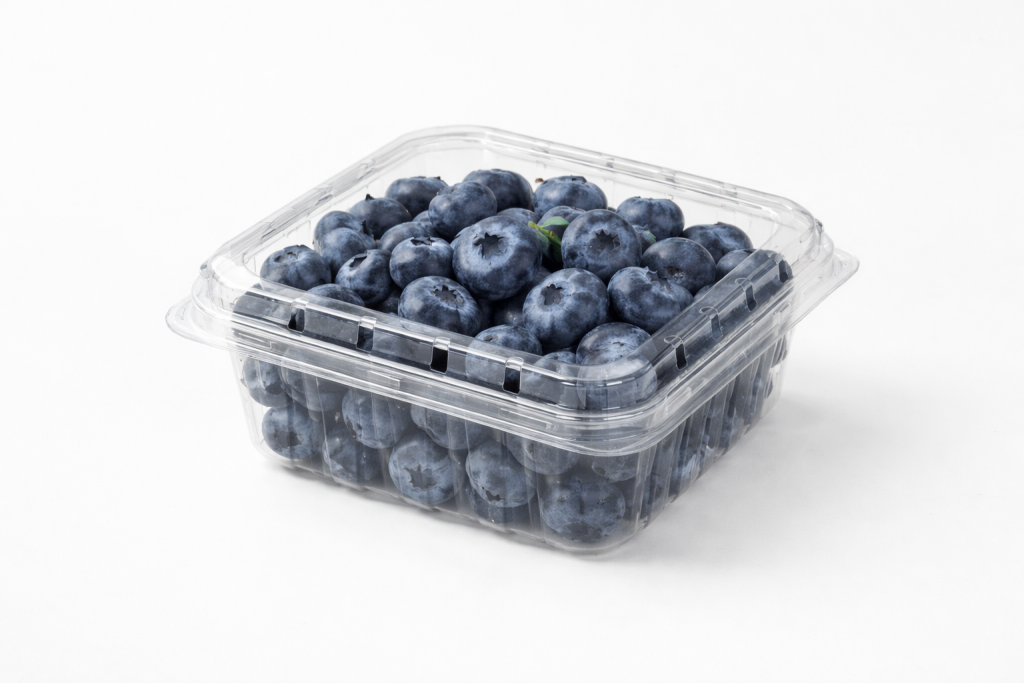
In the context of the global fresh produce supply chain and modern multinational retail systems, food packaging has long evolved beyond the simple function of enclosing products. Instead, modern food packaging engineering regards packaging as a critical tool for extending shelf life, reducing storage losses, and enhancing visual merchandising impact on retail shelves. Among the wide variety of packaging materials and structural formats, clamshell containers stand out due to their integrated hinged structure, exceptional compressive strength, and outstanding compatibility with industrial automation systems, making them a global standard across fresh produce packaging, ready-to-eat meals, and premium retail applications.
Whether for large-scale commercial blueberry export operations or bulk procurement of food-grade packaging for supermarket chains, food brands and packaging procurement managers must make highly precise technical and commercial decisions. These decisions not only affect packaging procurement costs but also have a profound impact on moisture loss rates, spoilage rates during long-distance cold-chain transportation, and product conversion rates at the retail shelf.
Many inexperienced investors often overlook packaging specification and material standardization in the early stages of a project, resulting in significant losses during later processes such as automated washing, weighing, palletizing, and cold storage operations. From a fully industrial and commercial perspective, this article provides a comprehensive analysis of global mainstream design standards for plastic clamshell packaging, explores the physical principles behind ventilation structures and material rigidity in food preservation, and guides B2B procurement managers in selecting packaging solutions based on production and financial models.
1. Why Plastic Clamshell Containers Are a Mandatory Standard in Cross-Border Trade
In global fresh produce export supply chains, due to significant differences in food-contact material regulations across countries and the strict logistical requirements of major retail groups, manufacturers must adhere to international industrial standards when developing packaging containers.
1. Food-Contact Safety and Material Science Standards
To ensure safety when in direct contact with fruits, vegetables, or baked goods, high-quality plastic clamshell containers must meet extremely strict raw material control requirements. At present, food-grade PET (polyethylene terephthalate) is the dominant material used globally.
It must be clearly emphasized that packaging intended for commercial export must comply with stringent international food safety certifications. During manufacturing, raw materials must remain pure, and the use of low-grade or unidentified recycled industrial fillers is strictly prohibited. High-quality materials not only ensure resistance to brittleness under low-temperature cold-chain conditions but also prevent harmful chemical migration when exposed to the natural acidity of fruits, thereby fully safeguarding end-consumer food safety.
2. Ventilation Systems Aligned with Global Cold-Chain Aerodynamics
In commercial fresh produce packaging, ventilation design is never random; it is the result of precise fluid dynamics and thermal engineering calculations.
If packaging is fully sealed, the high respiration rate of harvested fruits generates significant heat and moisture. When exposed to cold-chain environments, this moisture rapidly condenses, creating ideal conditions for mold growth and leading to rapid spoilage. Therefore, high-standard plastic clamshell containers must incorporate scientifically designed ventilation slots and perforations on the top, bottom, and side panels. This design enables cold air in refrigerated environments to penetrate stacked pallets within minutes, rapidly removing field heat and physically extending shelf life.
2. Technical Applications of Plastic Clamshell Packaging Across Different Segments
In modern supply chains, different food categories require different packaging priorities. Procurement managers must therefore select packaging based on product characteristics and shelf-life requirements, as well as structural performance evaluation.
1. Food Delivery and Ready Meals: High Heat Resistance Requirements
In addition to fresh produce logistics, clamshell containers play a critical role in urban ready meals, fast food, and microwaveable prepared food systems.
Unlike produce packaging, which prioritizes breathability, foodservice clamshell packaging focuses on leak resistance and thermal stability. In such applications, materials are typically shifted from PET to heat-resistant polypropylene (PP). The edge locking system is highly engineered, often featuring double or triple sealing mechanisms. This ensures zero leakage during high-speed delivery of liquid-based meals and allows direct microwave reheating, perfectly matching the fast-paced demands of modern urban consumption.
2. Structural Rigidity in Industrial Automated Packaging Lines
In large-scale industrial packaging operations, containers must withstand mechanical handling forces from robotic grippers, high-frequency conveyor vibrations, and automatic labeling systems.
If low-quality plastic clamshell packaging is used without proper structural design, containers may collapse under vertical pressure during automated sealing processes, leading to product damage. High-quality industrial packaging incorporates multi-rib reinforcement structures along the sidewalls, distributing vertical loads evenly across diagonal structural points. This significantly improves production line efficiency and provides reliable mechanical support for downstream palletization.
3. Berry Containers: Lightweight Design and Anti-Bruising Engineering
For high-value and highly fragile fruits such as blueberries, raspberries, blackberries, and strawberries, the packaging industry has developed a dedicated engineering focus to meet extremely low-loss requirements in global berry trade.
1. Rounded Geometry for Fragile Fruit Protection
Due to the extreme delicacy of berry skins, even minor friction can cause surface damage, juice leakage, and rapid spoilage. High-quality berry containers are therefore manufactured using ultra-thin, high-transparency polymers via precision thermoforming processes.
To maximize protection, internal geometries are designed with smooth curves and no sharp edges. Additionally, premium packaging is often paired with absorbent cushioning pads at the base to absorb excess juice and reduce vibration during transport, ensuring optimal visual quality upon arrival.
2. Micro-Circulation Systems for Ethylene Control and Mold Prevention
After harvest, berries continue to exhibit high respiration rates and emit ethylene gas, which accelerates ripening.
In poorly designed packaging, ethylene accumulates rapidly within confined spaces, accelerating softening and degradation. Professionally engineered berry containers incorporate precisely calculated airflow ventilation systems that maintain internal humidity balance while removing excess ethylene and carbon dioxide. This creates a micro-circulation effect that effectively slows down the ripening process during long-distance transportation.
4. Clear Clamshell Containers: Visual Merchandising in Supermarket Retail
When applied to supermarket shelves displaying salads, fresh-cut fruit, premium desserts, or sushi products, packaging appearance and transparency become critical purchasing factors.
1. Optical-Grade Transparency Standards
In visually driven retail environments, optical clarity becomes a key commercial differentiator.
High-quality clear clamshell containers must be free from haze, yellowing, or distortion. They must present food products with crystal-like transparency, fully showcasing freshness, color, and texture. High transparency not only signals cleanliness and food safety but also significantly increases consumer purchase intent, enabling brands to achieve premium positioning and higher profit margins.
2. Surface Tension Control for Condensation Management
During cold-chain transitions, temperature differences often cause moisture condensation on packaging surfaces.
If condensation accumulates into droplets and falls onto food products, it can accelerate mold growth and damage shelf appearance. High-standard clear clamshell containers utilize micro-scale surface tension engineering to transform condensation into a thin film that flows along container walls into drainage channels. This prevents direct contact between water and food while maintaining optical clarity and significantly reducing retail spoilage rates.
5. Automation Compatibility and High-Efficiency Packaging Operations
In modern industrial food processing facilities, packaging efficiency directly determines throughput and cost per unit.
1. High-Speed Denesting Performance
In fully automated production lines, empty containers are separated using suction and air-flow systems.
Poor dimensional tolerances can cause containers to stick together due to vacuum adhesion, leading to line stoppages. High-quality clamshell containers integrate anti-adhesion lugs that maintain consistent spacing during stacking, ensuring smooth high-speed denesting and significantly improving production efficiency.
2. Automated Weighing and Sealing Integration
After filling and weighing, containers pass through automatic sealing systems.
Locking mechanisms are critical: overly tight locks can cause breakage, while loose locks may result in accidental opening during transport. High-quality containers use engineered audible click-lock systems that ensure secure closure with minimal pressure while guaranteeing stability throughout downstream logistics.
6. Financial Analysis: How Packaging Impacts ROI in Food Supply Chains
In procurement decision-making, focusing solely on unit cost is a common financial mistake. Packaging must instead be evaluated across its full lifecycle cost.
1. Reduction of Shrinkage Rate
In retail environments, product spoilage is one of the largest contributors to profit loss. Without high-quality packaging, berry loss rates can exceed 10% during distribution.
Even a slight increase in packaging cost per unit can be justified if it reduces spoilage from 10% to below 2%, generating substantial net profit improvement at scale.
2. Geometric Optimization for International Pallet Efficiency
In global B2B trade, refrigerated shipping container costs represent a major portion of landed cost.
Efficient packaging design is based on pallet geometry optimization at millimeter precision. High-quality clamshell containers are engineered to maximize pallet utilization, eliminating wasted space and ensuring that every cubic meter of refrigerated container capacity is fully converted into revenue-generating goods.
Conclusion
In conclusion, the widespread reliance on clamshell containers across modern agriculture, retail, and foodservice industries is not a trend-driven phenomenon, but the result of long-term industrial validation and comprehensive supply chain optimization.
From precise airflow regulation and ethylene control in post-harvest physiology, to high-precision anti-adhesion structures in automated production systems; from optical-grade transparency enabling retail premiumization, to logistics-optimized geometry reducing global freight inefficiencies—every detail of a high-quality plastic clamshell container contributes to the performance of the modern food supply chain.
In an era of increasingly stringent global food safety regulations and rising consumer expectations for freshness and quality, those who achieve the optimal integration of engineering innovation and cost efficiency in packaging design will ultimately secure a decisive competitive advantage in the global commodity supply chain.